Poker Online: How to Play, Choose a Format and Get Access to the Game
Author: Claire Bennett, senior editor for iGaming content and poker site analyst · Fact-check: editorial team · Last reviewed: February 2026 · Reading time: about 14 minutes

Author: Claire Bennett, senior editor for iGaming content and poker site analyst · Fact-check: editorial team · Last reviewed: February 2026 · Reading time: about 14 minutes
«Any review of a poker platform or format should start with legal conditions, licensing checks and rule transparency, not with promises of big wins or a flashy welcome bonus. Our editorial principle does not change: restrictions, withdrawal mechanics and risks come first, and the advantages at the table come second.» Claire Bennett, senior editor for iGaming content and poker site analyst
A quick word on method, because it explains why this guide reads the way it does.
We assess poker platforms and formats in a fixed order: legal status for Australian residents, licensing and audit documents, rake and fee model, deposit and withdrawal rules, KYC requirements, then game selection and player traffic. Bonuses and promotions come last, never first. If a term cannot be verified in public documentation, we say so instead of guessing.
For legal and statistical claims we rely on primary sources: the consolidated text of the Interactive Gambling Act 2001, ACMA quarterly enforcement reports, ATO guidance, state regulators such as the VGCCC, and published research from ANU and the Australian Institute of Family Studies. Where a figure comes from our own editorial observation, it is labelled as such and never presented as academic research.
Last reviewed: February 2026. Terms, limits and processing times change, so treat every number here as a prompt to check the current version on the operator's own pages.
Online poker in 2026 is a broad ecosystem of digital card disciplines, reachable through browsers, dedicated desktop clients and mobile apps. Before placing a first bet, players need to understand the legal framework in their own jurisdiction, the difference between free practice modes and real money play, and the simple maths behind basic strategy.
While researching the digital entertainment segment, our team analysed traffic patterns and what users actually demand in terms of rule transparency. That material sits in our thematic iGaming case study. Updated: according to our internal editorial audit of user experience (a sample of support enquiries across one calendar quarter), after we introduced structured blocks describing fees, limits and withdrawal timeframes, enquiries about disputed conditions dropped by roughly a quarter. That is an internal observation, not independent research, but the practical conclusion holds: awareness of risks and rules is the first requirement for safer play.

Poker online is the digital adaptation of classic card games, letting participants play against each other or against the house through dedicated software in real time. Unlike a traditional land-based club, the online format gives instant access to dozens of disciplines, automates pot calculation and dealing, and offers several modes, from poker demo on play chips to tournaments with large prize pools.
The main advantage for a poker player on the internet is flexibility: conditions can be matched to skill level and budget. Modern platforms pool thousands of users, which keeps tables running at any hour. In exchange, the digital format demands a clear understanding of the software, of random number generators (RNG) and of the regulatory limits that apply in your region.
«33.4% of Australian adults took part in online gambling in the past 12 months.» Source: ANU Centre for Gambling Research, "Gambling participation in Australia 2024", Australian National University (2024). https://openresearch-repository.anu.edu.au
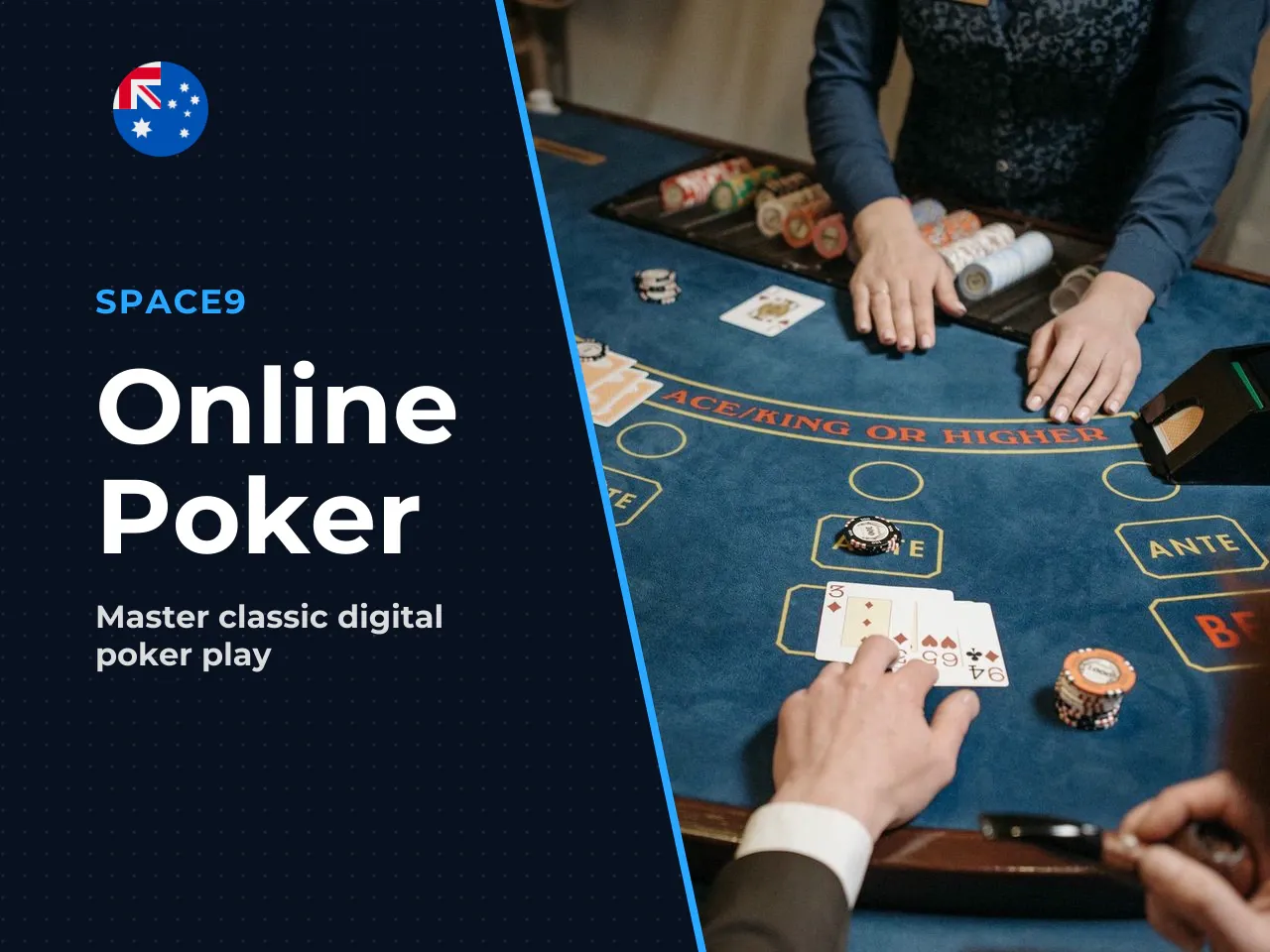
The key difference between available venues lies in the mechanics and in who your opponent is. Poker sites, meaning dedicated poker rooms, run peer-to-peer games where poker players compete only against each other, and the operator takes a commission (rake) for hosting the hands. Here your results depend on skill, on your poker strategy and on reading opponents.
A poker casino online works differently. It offers card games where the house is your opponent: Caribbean Stud, Three Card Poker or Casino Hold'em. These games carry a mathematical house edge that long-run strategy cannot erase. Beginners should keep the two categories firmly apart. Dedicated rooms suit the competitive, skill-based version of the game, while casino sections suit short sessions against a dealer.

«Providing interactive gambling services, including online poker, to Australian customers is an offence.» Source: Interactive Gambling Act 2001, consolidation of 11 June 2024, Australian Government. https://www.legislation.gov.au/Details/C2024C00176
The poker live dealer format combines the convenience of an online interface with the physical credibility of a real venue. Play is streamed in high definition from purpose-built studios, and a professional croupier deals the cards. No RNG algorithm shapes the outcome, because the result depends on a physical shuffle and a real deck on a real table.
In a poker live casino section, players watch every dealer action through interactive cameras and act through a digital menu. Updated (source clarified):
«In 2024 the ACMA blocked hundreds of illegal offshore sites offering casino games, including poker, blackjack and roulette, as breaches of the Interactive Gambling Act.» Source: ACMA, "Action on interactive gambling", quarterly reports (2024). https://www.acma.gov.au/action-interactive-gambling
One caution worth repeating. Most live games belong to the category where you bet against the house rather than against other players at the table, and an attractive video stream does not change the operator's built-in edge.
Comparison of online poker formats
| Parameter | Poker demo | Poker online (RNG) | Poker live dealer | Poker real money (P2P) |
|---|---|---|---|---|
| Main purpose | Learning rules and mechanics | Fast play against software or players | The feeling of being in a casino | Competing for real money |
| Financial risk | None ($0) | Low to high | Depends on table limits | High (risk of losing capital) |
| Real stakes involved | No (play chips) | Yes | Yes | Yes |
| Best suited to | Beginners, strategy testers | Multi-tabling enthusiasts | Players who value atmosphere | Experienced and regular players |
Read in plain text, the table says this: demo mode costs nothing and teaches mechanics, RNG tables suit volume play, live dealer tables suit atmosphere at table-set limits, and P2P real money play carries the highest risk to your capital.
This is the most practical question for an Australian player, so we have put the answer in one block rather than scattering it through the guide.
1. What the law says. Under the Interactive Gambling Act 2001 (IGA, consolidated as at 11 June 2024), providing real money interactive gambling services, online poker included, to Australian residents is an offence, regardless of where the operator sits physically. The 2017, 2019 and 2024 amendments tightened controls further, notably by banning credit cards and cryptocurrency for gambling payments.
2. Who is penalised. IGA liability is aimed first at operators and service providers, not at the individual player. That is not the same as zero risk. A player sending funds to a blocked offshore site has no internal protection mechanism at all: a complaint about unfair "house rules" or a stalled payout has nowhere to go.
«Between April and June 2024 the ACMA conducted 14 investigations, found 17 breaches and blocked 50 sites providing prohibited interactive gambling services, including poker.» Source: ACMA, "Action on interactive gambling: April to June 2024" (2024). https://www.acma.gov.au/action-interactive-gambling
3. Land-based and club poker. Tournaments outside casinos, in pubs, sporting and community clubs, are allowed where entry is free or where all money collected is returned to players as prizes in full, with nothing retained by the organiser for running the game. Break those conditions and the tournament becomes illegal. Under the Victorian regulator's rules (VGCCC, Gambling Regulation Act) the penalty reaches 1,000 penalty units or 2 years imprisonment, or both. The regulator also warns that its oversight of games outside casinos covers legality only: it does not review a table's house rules and cannot force an organiser to pay a prize.
4. Tax on winnings. In Australia, recreational players' winnings have traditionally been treated as incidental income and excluded from assessable income, so a hobby player does not declare them. The picture changes when play becomes systematic and professional: the activity may then be characterised as a business, with taxable income. The ATO also notes that income from illegal activity is taxable, while related expenses and losses cannot be claimed as deductions.
5. Legal alternatives: social poker and club apps. If real money deposits are off the table legally, several fully legal play-chip formats remain:
⚖️ Disclaimer. This information is general in nature and does not replace advice from a legal, tax or financial professional. Laws on online gambling and the taxation of winnings vary by jurisdiction and change over time, so check current legislation and your state regulator's position.
The first real decision before a session is the mode: no-deposit demo (poker demo) or play for actual funds (poker real money). Demo versions let you test the interface safely, learn the betting order and absorb the basic rules with nothing at stake. Real money play adds the psychological factor, financial discipline and genuine analysis of opponents' ranges.
«Among Australian adults, 33.4% gambled online in the past 12 months, and the share of players showing signs of risky behaviour rose from 11.6% to 13.6% across 2023 to 2024.» Source: ANU Centre for Gambling Research, "Gambling participation in Australia 2024" (2024). https://openresearch-repository.anu.edu.au
Analysts add an important caveat here. Play-chip games do not reflect real behaviour at the table, because the absence of financial risk changes the expected value of decisions and makes opponents act more or less at random.
Poker demo mode is ideal while you are meeting the discipline and testing unfamiliar software. Virtual chips let a newcomer work through the action order (fold, check, call, raise) without time pressure, understand how pots are built, and learn to read hand strength instantly at showdown.
What demo mode actually solves:
Switching to poker real money changes the psychology of the game entirely. With actual funds in play, poker players become noticeably more selective. Mistakes that cost nothing in demo mode now cost a slice of your stack.
The decisive factor in real games is bankroll management. Gambling researchers, along with harm-reduction reporting such as NHS England (2024), stress that real stakes demand strict self-control. Without the ability to handle emotional pressure (tilt) and without firm stake limits, even deep theoretical knowledge will not prevent fast losses.
«A national pilot study identified around 550,000 high-risk gamblers in Australia, most of whom show additional markers of harm.» Source: Australian Gambling Research Centre, "National Gambling Prevalence Study Pilot 2024", AIFS (2024). https://www.aifs.gov.au/agrc
A practical readiness test: you make consistently sound decisions regardless of how the last few hands went, you have a separate gambling budget unconnected to essential expenses, and you know in advance the loss point at which the session ends. If even one item is missing, stay in demo mode a while longer.
⚠️ RESPONSIBLE GAMBLING Playing poker for real money always carries the risk of losing capital. Real money play is restricted to those who meet the legal age requirement (18+, or 21+ in some jurisdictions). Poker should not be treated as a source of income or a way to solve financial problems. Safety recommendations:
- Set firm deposit and loss limits before the session starts.
- Never play with borrowed money or funds you need for living costs.
- At the first sign of losing control, use self-exclusion tools or contact a support service (in Australia, Gambling Help Online).
ℹ️ Disclaimer. This information is general in nature and does not replace legal or financial advice. Online gambling law varies by jurisdiction.
Modern online poker covers many variants, differing in the number of hole cards, the rules for forming hands and the structure of competition. The most popular poker games worldwide remain Texas Hold'em and Omaha, available both as single cash tables and inside large tournament series.
Updated (wording clarified): Texas Hold'em remains the most widespread poker discipline. It dominates the schedules of the biggest series, WSOP bracelet events included, and forms the backbone of most lobbies. There is no public, verifiable statistic with a documented methodology that would let us state the exact share of Hold'em hands dealt online, so we do not quote a percentage. Omaha holds second place thanks to its higher tempo and greater variance: the player receives four hole cards but must use exactly two of them together with three community cards.
Texas Hold'em is the baseline format of online poker and the recommended starting point for everyone. Each poker player at the table receives two face-down hole cards, after which five community cards are dealt to the board in stages. The task is to build the best five-card hand from any combination of hole and community cards.
Simple rules, deep strategy. Betting runs across four stages (preflop, flop, turn, river), which gives players plenty of room for mathematical calculation, bluffing and positional pressure.
Every poker variant splits into two organisational formats: cash games and tournaments. The choice depends on available time, playing style and personal tolerance for swings.
Format selection matrix for different experience levels

| Format | Rule complexity | Pace and dynamics | Session length | Recommended level |
|---|---|---|---|---|
| Texas Hold'em Cash | Low | Moderate | Flexible (from 15 minutes) | Beginner / recreational |
| Omaha Cash | Medium | High (high variance) | Flexible | Experienced player |
| Multi-Table Tournaments (MTT) | Medium | Rising through the event | Fixed (up to several hours) | Recreational / professional |
| Sit & Go (SNG) / Spin games | Low | Very high (turbo) | Short (10 to 30 minutes) | All player categories |
In short: if your time is unpredictable, cash tables and Sit & Go games fit better, while MTTs reward players who can commit several uninterrupted hours.
To play confidently at any table you need the basic poker rules to be automatic. Understanding the dealing mechanics, the order of betting and the hierarchy of hands lets you avoid technical errors and focus on strategic decisions.
Each hand is a sequence of betting rounds. The pot goes either to the last remaining player (once everyone else folds) or to the holder of the strongest hand at showdown.
Classic disciplines (Hold'em, Omaha) use a standard 52-card deck. The strength of a poker hand follows a strict hierarchy of ten combinations, from weakest to strongest:
When two players hold the same category of hand, the winner is decided by the kicker (the highest unpaired side card) or by the ranks inside the combination. Some worked examples: A-K-Q-J-9 beats A-K-Q-J-8 on the final kicker; with two pair you compare the top pair, then the second pair, then the kicker; with a full house the trips decide it (K-K-K-2-2 beats Q-Q-Q-A-A); and identical hands split the pot.
Each hand starts with compulsory forced bets, the small blind and the big blind. They are posted by the two players seated to the left of the dealer button. Blinds create the initial pot that everyone then competes for.
In every betting round, players have four options:
Action moves clockwise. Preflop, the first player to act sits to the left of the big blind; on the flop, turn and river it is the first active player to the left of the button. After the final round of betting on the river, cards are shown and the winner is determined automatically.
Land-based poker rooms, including the codes of conduct at major casinos, and international tournament rules require more than mechanical knowledge. They expect correct behaviour:
⚠️ Disclaimer. This information is general in nature and does not replace professional advice. No strategy guarantees a win; poker contains an element of chance and carries the risk of financial loss.
A workable poker strategy rests on mathematics, probability assessment and discipline, not on intuition or guessing an opponent's exact cards. The beginner's central task is to learn to make decisions with positive expected value (+EV) over the long run.
Even the best-designed strategy will not win every individual hand, because variance exists. Across thousands of hands, though, a disciplined approach consistently beats chaotic play.
The foundation for a newcomer is preflop selectivity, the tight-aggressive style. The most common beginner error is entering pots with almost anything, hoping to connect with the flop.
Principles of sound starting-hand selection:

Updated (data status clarified): as part of an internal editorial observation, we reviewed a 5,000-hand training sample at microstakes. A player who cut their voluntary put in pot (VPIP) from 42% to 18% through disciplined preflop folding lost noticeably less on early streets and finished the sample in profit. This is an editorial case study without academic methodology or a control sample. It shows a direction for improvement, not a promise of results.
The other critical skill is judging your poker hand honestly, in both absolute and relative terms. A made hand such as a pair of aces or a small set can look impressive, yet its real value drops sharply on a paired or four-flush board.
When you assess a spot, always look at:
«Fast, high-frequency gambling products with a continuous betting cycle carry the greatest risk of harm, regardless of a player's skill level.» Source: Grattan Institute, "A better bet: How Australia should prevent gambling harm" (2024). https://grattan.edu.au/report/a-better-bet

🔍 FACT CHECK / EXPERT VERIFICATION No poker strategy guarantees a win in a single hand. Poker is a game of incomplete information with a pronounced element of chance in the short run.
- Professional player Daniel Negreanu has noted: "You can make an absolutely perfect decision in terms of mathematics and expected value (+EV) and still lose the pot because your opponent hits the card they need on the river. Judge the quality of the decision, not the one-off result" (PokerStars Educational Insights).
- Poker theorist Phil Galfond stresses that a mathematical edge only becomes visible across tens of thousands of hands (Run It Once Analysis).
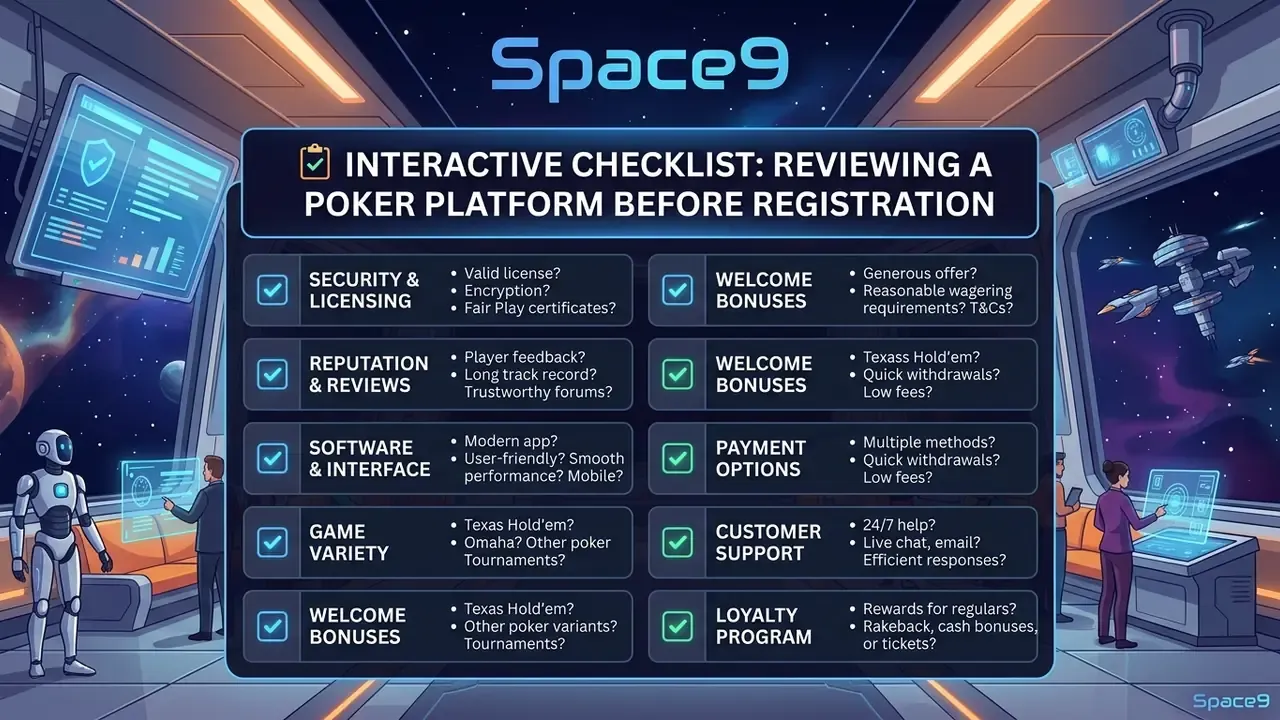
Choosing a reliable gaming platform is the decisive step before you create an account or deposit. You need to assess the operator's legal standing, its independent audit certificates, the range of available poker games and the convenience of the withdrawal options.
Regulatory frameworks differ sharply by region. In Australia, the Interactive Gambling Act 2001 (IGA) tightly restricts the commercial supply of online poker to local residents, and the ACMA regularly blocks access to unlicensed offshore sites. That is precisely why players should check a platform's jurisdiction and terms of service with real care.
«65.1% of Australian adults gambled in at least one form in the past 12 months, and 31.9% did so regularly, at least once a month.» Source: Australian Gambling Research Centre, "National Gambling Prevalence Study Pilot 2024", AIFS (2024). https://www.aifs.gov.au/agrc
Before you play poker on any chosen site, run a first-pass reliability audit on these points:
Check separately whether the site appears on the blocked list. Across April to June 2024 the ACMA ran 14 investigations, recorded 17 breaches and secured the blocking of 50 sites offering prohibited interactive gambling services, poker included. The register of ACMA actions is public, so a two-minute search is enough. Playing through a mirror domain of a blocked site means no payment protection and no dispute mechanism whatsoever.

⚠️ Final disclaimer. This material is informational, intended for readers aged 18+ (21+ in some jurisdictions), and is not legal, tax or financial advice, nor an encouragement to gamble. Gambling involves the risk of losing money. If play stops being entertainment, use self-exclusion tools and seek support (in Australia, Gambling Help Online, 1800 858 858).