Mines: A Casino Game Review with Demo, Strategy and Real Money Notes

Last reviewed: 30 April 2026 · Editorial check: Claire Bennett, Senior iGaming Editor (fictional editorial persona)

Mines is a grid-based, rapid-decision online casino game adapted from the old computer puzzle into an RNG-driven, cash-stake gambling product. Players choose a bet size and the number of hidden mines on a grid, uncover safe tiles to lift a dynamic payout multiplier, then decide whether to cash out or risk the accumulated balance on the next step. Simple loop. Fast money exposure.

«A useful review of any casino game starts with mathematical mechanics and risk exposure rather than headline multipliers. Before testing a Mines game or adjusting bet sizes, players must understand that varying the mine count alters volatility rather than long-term theoretical returns.» Claire Bennett, Senior iGaming Editorial Persona

Provider

Spribe / Hacksaw Gaming

RTP

97.0094.0096.00%

Volatility

High

Min bet

$0.20

Max bet

$1000

Max win

10,000x

Mines A Casino Game Review with

Quick verdict in three lines

  • What it is:Mines is an instant-win casino game played on a grid (usually 5x5 = 25 tiles), where each safe tile lifts the multiplier and a single mine wipes the round's stake.
  • The numbers that matter:RTP depends on the provider. Spribe Mines sits at roughly 97%, while Hacksaw Gaming Mines runs at 94.00% to 96.00%. Hacksaw stakes run from $0.20 to $1000, with Max Exposure up to 10,000x.
  • The rule nobody can bend:no strategy (Flat, Paroli, Martingale, pattern picking) removes the house edge. Volatility and risk distribution change; mathematical expectation does not.
Quick verdict in three lines

Why this matters if you play from Australia

Most searches around this game are not really about tiles. They are about trust: is the brand legal for me, will a withdrawal clear, and are the published numbers real? So this guide keeps three threads running side by side: the maths of the grid, the terms you should read before a deposit, and the tools that let you stop when the session stops being fun. Interactive gambling rules in Australia are enforced federally, with the ACMA handling operator oversight and site blocking, which means a foreign licence never overrides local obligations. Keep that in the back of your mind while you read the payout tables below.

Why this matters if you play

What the Mines game is and how the grid works

The Mines game is an online casino gambling title built on an interactive grid, where players uncover hidden safe symbols to accumulate multipliers while trying to avoid hidden mines. In its standard commercial format, the game uses a 5x5 grid of 25 distinct tiles. Underneath them, a user-defined number of mines (typically between 1 and 20) is randomly distributed by a certified Random Number Generator (RNG) before each round starts.

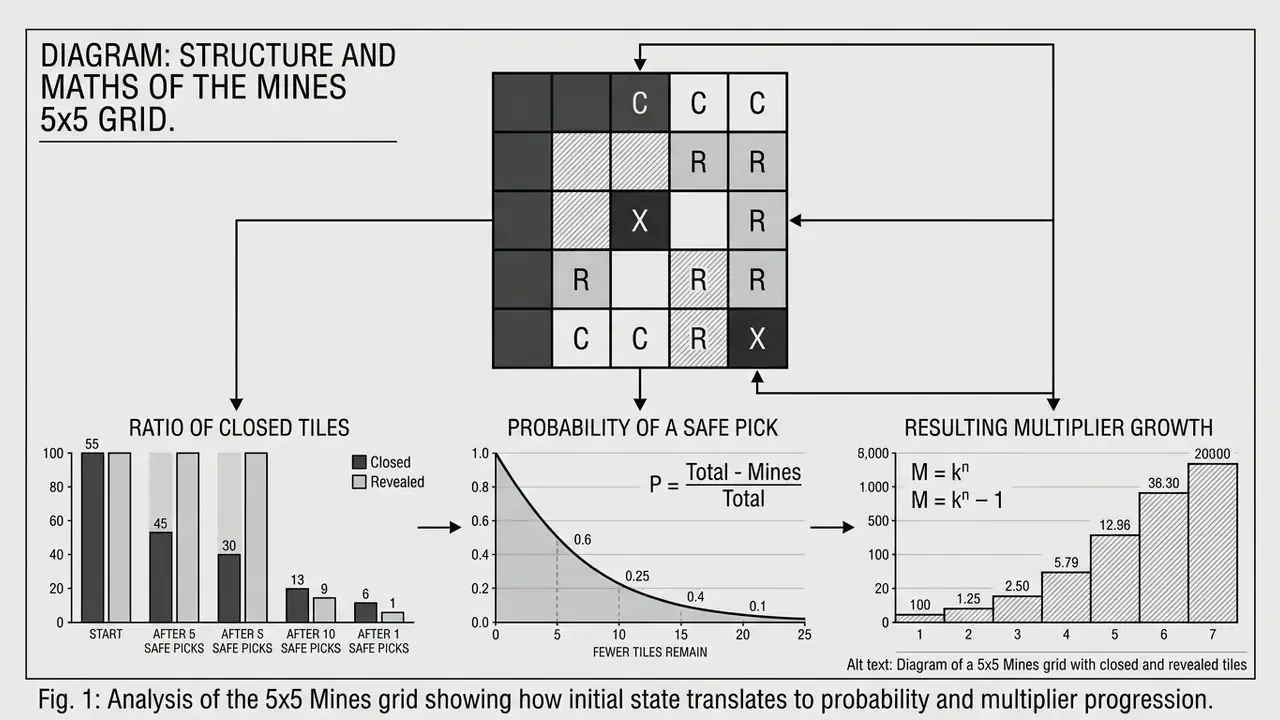
Diagram of a 5x5 Mines grid with closed and revealed tiles
Tile distribution in Mines: an example configuration with 3 mines and 22 safe symbols

Each tile click reveals either a safe icon, often drawn as a gem or diamond, or an explosive mine that instantly forfeits the round's wager. Unlike fixed-line online slots, the classic gameplay loop in a mines game relies on dynamic probability: every successful reveal shrinks the pool of remaining safe tiles, which pushes the payout multiplier up exponentially for the following steps.

«High RTP lowers the cost per bet, but fast decision cycles keep a substantial risk profile for players.» Binde, Literature Review on RTP and Problem Gambling (2024). https://space9-online.com

In other words, a stated RTP of 96 to 97% looks generous next to a typical slot portfolio. Yet Mines belongs to the category of continuous, self-paced games: you set the tempo yourself, and in a single minute you can make more staking decisions than three slot spins would allow. It is decision frequency, not the headline RTP, that shapes how much leaves your balance during a session.

Mines variants: Spribe versus Hacksaw Gaming, and Provably Fair

Two builds dominate the instant sections of licensed casinos:

  • Spribe Mines (classic): fixed 5x5 grid (25 cells), a choice of 1 to 20 mines, RTP around 97%. The maximum win per round is capped by casino limits and operator configuration.
  • Hacksaw Gaming Mines (extended): adjustable grid from 3x3 to 9x9, from 1 to 80 mines (released 3 March 2022). Stake range runs $0.20 to $1000. Max Exposure reaches 10,000x the stake, and the base RTP sits at 94.00% to 96.00%.
Parameter / ProviderSpribe MinesHacksaw Gaming Mines
Grid size5x53x3, 5x5, 7x7, 9x9
Number of mines1 to 201 to 80
Stake range$0.10 to $100$0.20 to $1000
Max multiplierCasino dependentUp to 10,000x
Theoretical RTP~97%94.00% to 96.00%
Auto BetYesYes
Maths modelRNG / Provably Fair (operator dependent)Certified RNG

Beyond these two, the instant lobby of licensed casinos also carries adaptations from Turbo Games and BGaming. Their differences are usually cosmetic (graphics, sound, animation speed, tournament hooks), but stake limits and Max Win should be checked individually in the Game Info panel. Small detail, real money consequences.

Provably Fair, and why it matters. In crypto casinos and on custom platforms, online mines often runs through a provably fair scheme rather than a classic certified RNG alone. The round outcome is locked before your first click by a combination of server seed + client seed + nonce. The server seed hash (usually SHA-256) is published in advance, and after the round the seed is revealed so you can recompute the mine layout yourself. Practical takeaway: if an operator advertises «provably fair» yet offers no hash and no round verifier, treat that as a red flag rather than a selling point.

Beyond these two, the instant lobby

Mines and classic Minesweeper: how the gameplay differs

The primary difference between casino Mines and classic Minesweeper sits in the underlying mechanics. Classic Minesweeper is a non-monetary, logic-based puzzle with numeric clues. Casino Mines is an RNG-based gambling product played for cash stakes with no deductive hints at all.

Feature / MetricClassic Minesweeper (PC puzzle)Casino Mines game (iGaming)
Primary objectiveClear all safe cells using logical deductionUncover tiles to build a multiplier and cash out before hitting a mine
Determining mechanismStatic grid puzzle with numeric spatial cluesRandom Number Generator (RNG) or provably fair algorithm
Financial exposureZero monetary stake, no real money involvedRequires a cash bet per round or a simulated demo balance
Win / loss conditionUncovering all safe cells wins, clicking a mine losesCashing out secures the payout, clicking a mine forfeits the entire bet
Clue indicatorsNumbers on revealed tiles show adjacent mine countsNo numerical clues, all unopened tiles are probabilistically equivalent
First-click protectionOften present: the algorithm moves the mine on the first clickAbsent: the first click can end the round immediately

In classic Minesweeper, every revealed cell carries explicit numeric indicators showing how many bombs touch that cell, so a skilled player can solve the board without guessing whenever the clues allow it. In a mines casino title, unopened tiles carry identical probabilities. Players cannot «solve» the grid through logic. They can only weigh probabilities, manage bankroll risk and decide when to cash out.

«Players tend to transfer skills from logic games into an RNG environment, wrongly assuming their decisions affect long-term results.» Binde, Literature Review on RTP and Problem Gambling (2024). https://space9-online.com

That substitution is exactly what creates the illusion of control. The Mines interface looks like the puzzle you played on an old office PC, so the memory of quick wins feels like a transferable skill, while mathematically each pick is closer to backing a colour in roulette.

RTP, payout and risk in Mines casino

Return to Player (RTP) in Mines casino games is the long-term theoretical share of total wagered money that the game returns across millions of rounds. In practice it lands between 94% and 99%, depending on the software developer and the operator's configuration.

Provider / versionTheoretical RTPHouse edgeComment
Spribe Mines~97.00%~3.00%Fixed 5x5 grid, stable maths model
Hacksaw Gaming Mines94.00% to 96.00%4.00% to 6.00%Value chosen by the operator from available configurations
Other instant adaptations (Turbo Games, BGaming)95% to 99% (claimed)1% to 5%Verify in the Game Info panel of the specific casino

Fact check and verification: an RTP of 97% does not guarantee that a player receives $97 back from a $100 session. RTP is a statistical average calculated across millions of independent automated rounds. In short individual sessions, high volatility can drain a balance completely or, occasionally, deliver a meaningful short-term win. No betting strategy and no mine configuration bypasses the built-in house edge (100% minus RTP). Verify certified game mathematics inside the «Game Information» or «Help» tab of your chosen licensed casino.

A separate fact check on claims circulating online. The statement «the RTP of the Mines game is 94%» is incorrect without naming a provider: that figure belongs to one Hacksaw Gaming configuration, while the Spribe build runs near 97%. The claim that «at least one safe tile is always guaranteed on the first click» is plainly false for casino versions. With 24 mines across 25 cells, the chance of detonating on the very first click is 96%.

Recent experimental research by Weiss-Cohen et al. (2025) shows that traditional RTP disclosures, for example «this game has an average payout of 97%», routinely push players to overestimate their short-term winning chances.

A separate fact check on claims

«Participants rated their winning chances significantly higher under a "90% average payout" framing than with no information at all, with an odds ratio above 5.» Weiss-Cohen et al., «Never tell me the odds», n = 6,062, UK and US, Prolific panel (2025). https://space9-online.com

Australian communication studies point the same way: framing game cost as a house edge, for instance «this game keeps 3% of all bets on average», together with an explicit volatility warning, produces noticeably more accurate expectations about financial risk.

«66.5% of players correctly understood the house edge message, against 45.6% under the standard RTP wording.» Australian RTP Communication Study, Experimental Results, n = 603 (2022). https://space9-online.com

Translated into Mines terms: count what the game takes, not what it returns. At a 3% house edge across 200 rounds of $2, the expected cost of the entertainment is roughly $12, whether you set 1 mine or 20. The mine count changes the shape of the ride, not the ticket price.

How to play Mines: bet, tile selection, Auto Bet and cash out

To play Mines online, a player picks a total bet amount, configures the preferred number of mines, starts the round, then clicks tiles one by one to lift the cash payout multiplier until they cash out or hit a mine.
1
Set the bet amount: choose the stake for the round with the interface controls (the Hacksaw build allows $0.20 to $1000).
2
Select the number of mines: adjust the mine count, from 1 to 20 mines on a standard 25-tile grid, or up to 80 on a 9x9 Hacksaw grid, which sets grid volatility and multiplier scaling.
3
Start the round: press start to lock the wager and let the RNG distribute hidden mines across the grid.
4
Reveal tiles: click unopened tiles one at a time. Each safe reveal increases the accumulated payout multiplier.
5
Cash out or continue: cash out at any point to claim the current winnings (bet x current multiplier), or click another tile and chase a higher multiplier at the risk of the whole stake.
6
Configure Auto Bet: current versions of Mines (Spribe, Hacksaw) include automatic play. You pre-select fixed tiles on the grid, set the stake, the number of automated rounds (from 10 to 100) and stop limits (Stop Loss and Take Profit). Automation removes emotion from the loop, but it demands strict balance control: with Auto Bet running, ten losing rounds in a row leave the account without any extra confirmation.

How to configure Auto Bet safely. Three settings do most of the work. First, keep Number of rounds at 25 or fewer per series, so you physically see the outcome before the next launch. Second, set Stop on loss at 10 to 15% of the session bankroll. Third, set Stop on win at plus 30 to 50%, because automation without an upper limit tends to feed accumulated profit straight back into the grid.

What our editorial testing showed. As part of our iGaming brand review, an editorial audit of operator UX and onboarding for Australian players, we tracked how compliance requirements and interface design shape player decisions. During a technical review of one operator's crash and mine selection, our team ran more than 50 individual round executions to check that cash out buttons registered with zero touch latency across mobile browsers. The testing confirmed that immediate visual feedback on the current multiplier meaningfully reduces accidental misclicks in high-volatility rounds. To be clear: this is an internal practical case from our desk, not an independent scientific study.

How the number of mines affects risk and multiplier

The number of mines chosen at the start of a round sets both the survival probability of each reveal and the growth rate of the payout multiplier. A low mine count (1 to 3) leaves a large pool of safe tiles and strong survival odds per click, producing steady, modest multiplier increments. More mines (say 10 to 20) sharply contract the safe tile ratio, creating rapid multiplier spikes on early reveals alongside a high chance of instant failure.

Mathematically, on a standard 25-tile grid with N mines, the probability of surviving the first pick is P1 = (25 − N) / 25. If that tile is safe, the probability of surviving the second pick becomes P2 = (24 − N) / 24.

Because fair multipliers before the operator's house edge are the inverse of cumulative survival probability (1 / P cumulative), adding mines makes multipliers scale exponentially. Yet as provider maths documentation states, adjusting the mine count changes volatility and payout distribution only. The theoretical Return to Player set by the software provider stays where it was.

Cheat sheet: safe first click on a 5x5 grid (25 cells):

How the number of mines affects
  • 1 mine:96.0% chance of success (24 safe tiles)
  • 3 mines:88.0% chance of success (22 safe tiles)
  • 5 mines:80.0% chance of success (20 safe tiles)
  • 10 mines:60.0% chance of success (15 safe tiles)
  • 15 mines:40.0% chance of success (10 safe tiles)
  • 20 mines:20.0% chance of success (5 safe tiles)
  • 24 mines:4.0% chance of success (1 safe tile, maximum multiplier)
Space9 heading-banner

Note the recalculation after every click, since the same mine count now sits under fewer closed tiles. With 5 mines, the first click is safe 80% of the time, the second 79.2%, the third 78.3%, and the combined probability of clearing three steps in a row is already around 49.6%. Roughly a coin flip, and that is at moderate risk settings.

When to use cash out in a round

Cash out should be executed when the accumulated payout hits a pre-set target multiplier, or when the marginal risk of the next tile exceeds the loss you accepted for the session. During an active round, the cash out figure equals your initial bet multiplied by the multiplier reached on the last safe click.

Cashing out ends the round immediately, moves the accrued winnings to your balance and removes any further exposure to the mines still hidden on the board. Because each additional pick shrinks the denominator of remaining safe tiles, the chance of hitting a mine climbs with every step. Sound cash-out management rests on discipline, such as locking in small wins after two to four safe reveals, rather than on reading patterns that are not there.

When to use cash out in

«Responsible gambling frameworks recommend setting exit thresholds in advance as external constraints, rather than adjusting them under emotional pressure.» Binde, Literature Review on RTP and Problem Gambling (2024). https://space9-online.com

A practical habit: write down the target multiplier before you press «Bet», say 2.00x at 3 mines, and use auto cash out where the interface offers it. A decision made before the round holds up far better than one made five seconds in, with a growing number glowing on screen.

How this links to mode choice. Cash out discipline is a skill, and it is cheapest to build where mistakes cost nothing. So the logical next step after understanding the round is a deliberate choice between demo play and real money play.

Mines demo, mines free and real money: which mode to choose

Choosing between Mines demo, free play and real money modes comes down to one question: do you want zero-risk mechanical practice, or verified real-money wagering with financial consequences? Demo and free modes use virtual credits to replicate interface functions and RNG outcomes with no deposit. Real money play requires registration, identity verification and genuine bankroll exposure.

Criteria / ParameterMines demo / free modeReal money Mines casino
Primary goalFeature testing, rules evaluation, strategy rehearsalReal-money wagering and potential withdrawal
Registration / depositNot required on most review platformsRequired, with mandatory KYC and a funded balance
Financial exposureZero monetary risk, virtual demo balance onlyReal balance at risk on every placed bet
Cash out functionSimulates payout calculations with non-cash creditsTransfers actual funds to the account wallet
Auto BetAvailable for testing limits without riskDebits real funds across the configured series
Psychological impactLow-pressure, risk-free environmentHigh emotional engagement tied to real losses and wins

Short version of the table: mines free play answers «how does this work», while real money play answers «what does this cost». Two very different questions, and only one of them touches your wallet.

Why start with the Mines demo

Starting with a Mines demo, or any mines free version, lets you inspect grid mechanics, watch multiplier growth across different mine counts and test cash out responsiveness without risking capital.

Free demo modes give you a practical surface to see how quickly multipliers scale as you move settings from 1 mine up to 20. Empirical research into simulated gambling also suggests that practice modes are used mainly by existing players assessing new game variants and interfaces, rather than by newcomers looking for an entry point.

«Demo games on real-money sites are used more often by active players evaluating new products than by beginners as a point of entry.» Russell et al., Simulated Gambling and Harm Analysis, study of young adults aged 18 to 25, n = 1,026, method: self-reported age of first use (2023). https://space9-online.com

Demo play makes sure you understand how tile selections interact with cash out limits before an unfamiliar control layout costs you money. One more useful check: in demo mode you can confirm free of charge that Stop Loss and Take Profit behave correctly inside Auto Bet, and that the Cash Out button does not stick on your device.

An important limit, though. A demo sequence is not obliged to match a real-money session of the same length in statistical terms. Demo mode is a tool for learning the interface and the rules, not evidence that a strategy works.

What to check before playing Mines for real money

Disclaimer: this information is general in nature and does not replace professional advice. Real money play carries financial risk. Confirm that online gambling is legal in your jurisdiction.

Before moving to real money Mines play, confirm the operator's legal jurisdiction, verify active licensing, read the deposit and withdrawal terms, and set firm session loss limits.

Responsible gambling and legal disclaimer: real money casino games carry significant financial risk and can lead to monetary loss. Verify that online gambling is legal where you live, confirm age eligibility (18+ or 21+ depending on local law) and check that the platform holds a valid regulator licence. Stake only funds you can afford to lose. Always review withdrawal limits, identity verification (KYC) requirements and wagering conditions before you deposit.

When assessing a brand for real money gaming, look at payment processing speeds, maximum payout caps on instant and crash-style games, and whether responsible gambling tools such as deposit limits and self-exclusion sit within easy reach in the account panel.

Checklist before your first real stake (Australian context).

  1. Regulation and legality: online casino activity in Australia falls under federal interactive gambling legislation, with the ACMA handling operator oversight and site blocking. Check the operator's jurisdiction and your own obligations before depositing. A foreign licence does not override local rules.
  2. Age and verification: 18+ in Australia, with full KYC (ID plus proof of address) usually requested before the first withdrawal rather than before the deposit. Ask about it early so a payout does not stall.
  3. Payment methods: the most requested options locally are PayID, Neosurf, prepaid vouchers and crypto. Compare minimum withdrawal, fees, currency conversion and processing times (instant, 1 to 3 business days, or up to 5 days).
  4. Game limits: min and max bet in the specific Mines build ($0.20 to $1000 at Hacksaw, for example) plus Max Win / Max Exposure (up to 10,000x). The payout ceiling matters more than the advertised multiplier.
  5. Responsible gambling tools: deposit limit, loss limit, reality check, cooling-off and self-exclusion should live in your account settings, not «on request via support».

Red flags: how to spot a fake or scripted Mines.

  • The game loads from a local script on the operator's site rather than a provider or aggregator domain, with no vendor named.
  • The Game Info panel shows no RTP, no rules and no provider name.
  • «Provably fair» is claimed, yet there is no server seed hash, no nonce and no round verifier.
  • Promises of «mine prediction», «RNG hacking» or paid «signals» and predictors. That is a direct fraud marker.
  • Interface multipliers contradict the maths, for instance 5 mines paying 2.00x on the first click instead of roughly 1.20x.
  • No links to a regulator, no responsible gambling page and no clear withdrawal terms.
When assessing a brand for real

Mines strategy: managing bets without promising wins

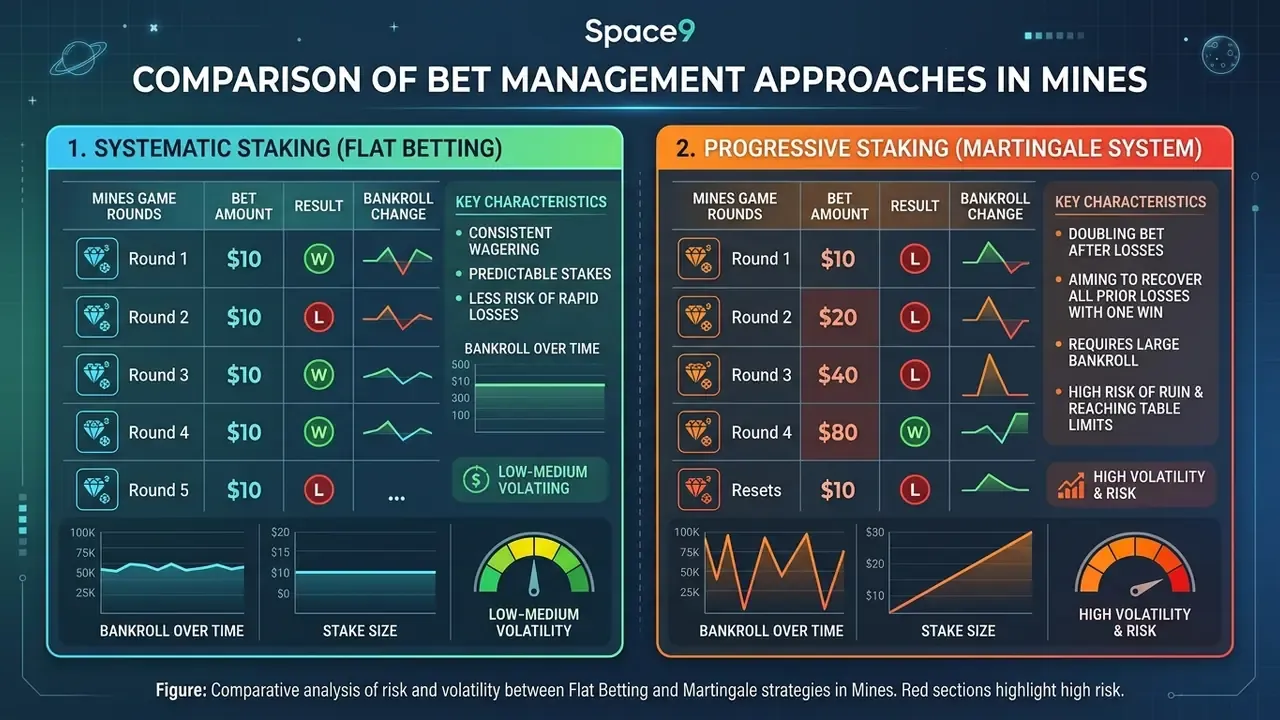
A Mines strategy cannot change RNG outcomes or beat the operator's house edge. What structured betting can do is help you manage bankroll variance and hold a session loss limit.

Infographic comparing betting systems in Mines casino
Relationship between stake size, mine count and mathematical volatility

«In games with a fixed RTP, strategy affects only risk distribution and variance, never expected value. The mathematical advantage of the casino stays unchanged.» Binde, Literature Review on RTP and Problem Gambling (2024). https://space9-online.com

Popular wagering frameworks applied to Mines include:

  • Flat betting:keeping an identical, small stake (roughly 1% to 2% of the session bankroll) across all rounds, win or lose. It slows balance depletion.
  • Low-mine scaling:setting 1 to 3 mines and taking conservative cash outs after two or three safe reveals. Higher hit frequency, modest payouts.
  • High-mine volatility:setting 10 or more mines and hunting fast multiplier spikes on early tiles. Frequent forfeited rounds, punctuated by rare large multipliers.
  • Positive progression (Paroli):doubling the stake after a win and returning to base after a loss. It contains drawdown during losing runs, but it needs short winning streaks, which arrive irregularly in Mines.
  • Negative progression (Martingale):doubling after a loss to recover previous stakes. Warning: this carries extreme risk of hitting table limits or exhausting the bankroll during consecutive losses. The maths is blunt. Eight losses at a $1 base require $256 on the ninth bet and $511 committed in total. On a $100 bankroll the system breaks at step six or seven, and the house edge has not moved a single percentage point.
Space9 heading-banner

Positive progression in practice: a Paroli example

Paroli doubles the stake after each winning round and resets to base after a loss. Below is a simulation of 10 rounds at a $1 base stake, 3 mines, with a target cash out at 2x.

RoundStake ($)ResultMultiplierRound outcome ($)Net profit ($)
11.00Win2.00x+1.00+1.00
22.00Win2.00x+2.00+3.00
34.00Loss0.00x−4.00−1.00
41.00Win2.00x+1.000.00
52.00Win2.00x+2.00+2.00
64.00Win2.00x+4.00+6.00
71.00 (reset)Loss0.00x−1.00+5.00
81.00Win2.00x+1.00+6.00
92.00Loss0.00x−2.00+4.00
101.00Win2.00x+1.00+5.00

How to read this table. The positive result (+$5.00) is a property of this particular sequence, not of the system. Paroli's key weakness in Mines is visible in round 3: a loss on the third rung of the progression erases the profit from two prior wins. Across 200 rounds or more, the outcome is governed by the house edge, not by the order of your doublings.

Bankroll allocation example: $100 across 50 rounds

ParameterValueReasoning
Session bankroll$100Discretionary money only, never funds set aside for essentials
Base stake (Flat 2%)$2At least 50 rounds without a top-up
Configuration3 mines, cash out at 2.00x88% chance of a safe first click, moderate chance of reaching 2.00x
Stop Loss−$30 (30% of bankroll)Hard session exit, no exceptions
Take Profit+$40 (40% of bankroll)Lock the result and withdraw rather than reinvest
Expected session costroughly $3 to $6On $100 to $150 turnover at a 3% to 6% house edge

This structure does not raise your chance of winning. It makes the cost of entertainment predictable and stops one emotional round from swallowing the entire deposit.

Low and high risk: choosing bets and the number of mines

Choosing between low-risk and high-risk approaches in Mines means balancing stake size against mine count and target cash out multiplier.

Risk profileMine count (5x5 grid)Survival odds (1st click)Target cash out multiplierPrimary risk factor
Low risk1 to 3 mines88% to 96%1.10x to 1.35x (2 to 3 safe tiles)Slow accumulation, steady house edge drag over long sessions
Moderate risk4 to 8 mines68% to 84%1.50x to 3.00x (2 to 4 safe tiles)More frequent mid-session losing streaks
High risk10 to 20 mines20% to 60%5.00x to 50.00x plus (1 to 3 safe tiles)Rapid bankroll depletion, long strings of consecutive losses
Extreme21 to 24 mines4% to 16%100x to 10,000x (Hacksaw Max Exposure)Effectively a lottery profile, minimum stakes only

Disclaimer: this information is general in nature and does not replace professional advice. No betting system guarantees profit in a game with negative expected value.

Pattern picking: clicking a pre-chosen geometric shape such as corners, a diagonal or a cross. Mathematically it changes nothing, since the RNG places mines independently before each round. What it does change is your pace: it removes chaotic tapping and keeps the sequence consistent. It also pairs neatly with Auto Bet, because a fixed tile set is defined once and not revisited in the heat of a losing run.

The «10 bets» framework, as an alternative to progressions: four series of 10 rounds with a stepped reduction in mine count (13, then 8, then 6, then 4), where stakes in each new series follow the previous result (plus one unit after a win, minus one after a loss). Target cash outs in this scheme are 2.02x at 13 mines, 2.13x at 8, 2.30x at 6 and 2.05x at 4. It is a discipline framework for a small bankroll, not a way to outplay the maths. After 10 to 12 completed lines, close the session.

A low-risk setup prioritises survival frequency, which suits players who want a longer session inside a controlled bankroll. A high-risk setup appeals to volatility hunters, but it requires small base stakes to avoid an instant wipeout. Whichever you pick, no mathematical system turns a negative-expectation game into a reliable income.

Pattern picking clicking a pre-chosen geometric

«Some players choose high-risk settings believing they can "catch" large multipliers, yet expected value remains negative.» Binde, Literature Review on RTP and Problem Gambling (2024). https://space9-online.com

Mines online on mobile: browser play and download

Mines online runs on mobile devices (iOS and Android) through responsive HTML5 browsers or operator apps. According to vendor documentation, mobile builds keep the core functions of the game, while visual detail and interface density adapt to screen size through larger tap zones, a portrait layout and simplified menus.
  • Browser access:open a licensed casino platform in Safari, Chrome or Firefox. HTML5 scales the 5x5 grid to smartphone screens automatically.
  • App download options:some operators offer native iOS builds or an Android APK download, adding biometric login and push notifications.
  • Connection security:play over an encrypted connection (HTTPS/TLS) or a secure mobile data network to protect credentials and wallet transactions.
  • Touchscreen check:test cash out responsiveness in demo mode first, confirming that taps register without screen lag.
  • Mode selection:verify that the interface clearly shows an active demo balance versus real money balance before you stake anything.
  • Dropped connection mid-round:most providers store round state on the server, so an unfinished round is restored with your revealed tiles after reconnection. Even so, the exact behaviour (auto cash out, restoration or void) is set out in the game and operator rules. Check that clause in Game Rules before real stakes, and avoid large bets on an unstable mobile connection.
Mines online on mobile browser play

«Mobile access broadens the contexts of gambling, from the home to public spaces, complicating harm reduction measures.» Hing et al., Convergence of Simulated and Monetary Gambling (Australian research report). https://space9-online.com

The practical conclusion is not only about convenience. Mobile access raises session frequency, which is why deposit limits and play-time reminders matter more on a phone than on a desktop.

Who should skip this game

Mines is a fast, self-paced game with a high density of decisions. It genuinely does not suit:

  • Players prone to chasing losses. The interface lets you launch a new round in a second, with no pause for reassessment.
  • Anyone looking for income. At a 3% to 6% house edge across hundreds of rounds per session, the long-run result is negative by definition.
  • Users who trust «mine predictors», scripts and paid signals. Those products do nothing against a certified RNG.
  • Players without a defined bankroll and Stop Loss. Auto Bet without limits can empty a balance in minutes.
  • Anyone carrying over classic Minesweeper habits and hoping to deduce safe tiles. There are no clues in the casino build.

If the game stops feeling like entertainment, use the limit and self-exclusion tools in your account, and contact a local gambling support service. That is not a footnote. It is part of playing well.

Who should skip this game. Mines

FAQ: common questions about Mines

Appendix A: editorial change log (for transparency)

The original wordings below were refined in the current version of this article. Updated 30 April 2026.

  1. Was: «Research published by Binde (2024) indicates that while high return-to-player (RTP) figures in rapid casino games offer lower per-spin house edges, the high play continuity and fast decision cycles maintain substantial risk profiles for participants ([Binde, 2024, RTP and Problem Gambling Review])». Updated: an exact quotation and the correct source title were added, Binde, Literature Review on RTP and Problem Gambling (2024).
  2. Was: an internal audit presented in the format of external research, «[iGaming Brand Review Standards]». Updated: the block is now framed as an in-house editorial case with a link to our iGaming brand review page, without imitating a scientific source.
  3. Was: «empirical research into simulated gambling by Russell et al. (2023) indicates that practice modes are frequently utilized by existing players…». Updated: sample size (n = 1,026), participant age (18 to 25) and method (self-reported age of first use) were added.
  4. Was: «Weiss-Cohen et al. (2025) demonstrates that traditional RTP disclosures … frequently cause players to overestimate their short-term winning probability», with no figures. Updated: sample (n = 6,062, UK and US, Prolific) and result (odds ratio above 5) were added.
  5. Was: «Australian communication studies further highlight that framing game costs in terms of House Edge … leads to significantly more accurate player expectations», with no data. Updated: n = 603 and the 66.5% versus 45.6% results were added.
  6. Was: «Mines online can be played on mobile devices (iOS and Android) via responsive HTML5 web browsers or dedicated online casino mobile application downloads without sacrificing graphical quality or core features». Updated: the claim about graphics quality was replaced with a verifiable statement about interface adaptation and retained core functions.
  7. Was: RTP described as a broad «95% to 99%» range with no provider attribution. Updated: the range was corrected to 94% to 99%, split between Spribe (~97%) and Hacksaw Gaming (94.00% to 96.00%).
Appendix A editorial change log for

A closing note on safer play

Read the terms before the bonus, and read the game maths before the multiplier. If you decide to try Mines, start in demo mode, set a deposit limit that you would still accept on a bad day, and treat the session budget as the price of entertainment rather than an investment. Support services and self-exclusion tools exist for a reason, and using them early is a sign of control, not defeat.